Sailing Two-Up: How to Brief, Call and Trust a Dinghy Crew
What changes when a second person gets in the boat, and how to turn a crew — new or experienced — into a help rather than a hindrance
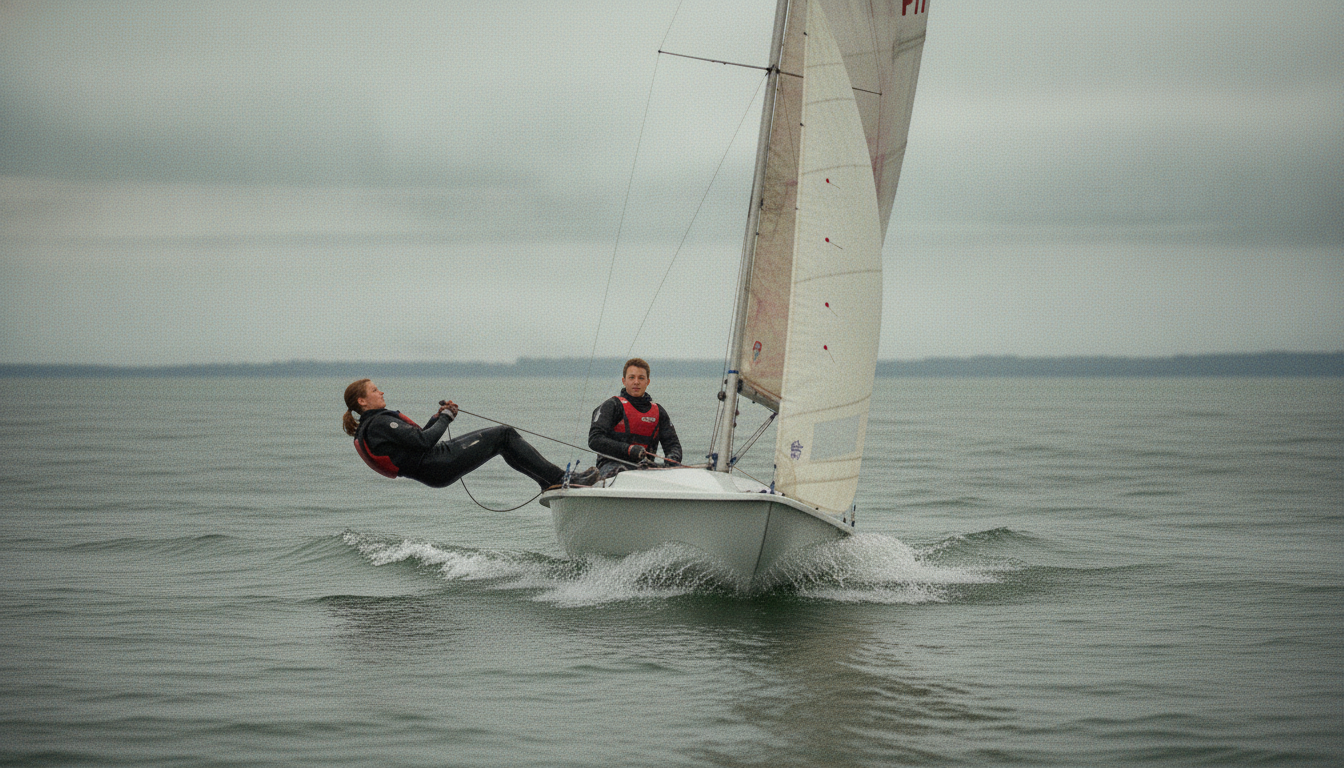
I sail a Topaz Xenon, a two-person dinghy, and I also sail it — foolishly — on my own. Singlehanded it’s slow and lumpy, but I’m slowly getting the coordination to race it that way. This post isn’t about that. It’s about the other half of the boat’s life: sailing it with a crew, and getting a crew to actually help instead of getting in the way. Most of it should carry over to other double-handed dinghies too.
Why singlehanded sailing is a different sport
Sail a boat like mine alone and you’re doing everyone’s job at once: mainsheet, tiller, jib, spinnaker, centreboard, kicker, downhaul and outhaul, while also balancing the boat, steering for the next mark and watching for the next gust.
It isn’t impossible, but it means one person doing ten things simultaneously—a load that a crew can help ease.
A quick glossary, because none of the advice below makes sense without it. A double-handed dinghy carries three sails: the mainsail, the big one behind the mast; the jib, the small one in front of it; and the spinnaker, the big balloon-shaped sail that lives in a chute at the bow until you’re running downwind. Each is controlled by a sheet — a rope held in the hand or on a cleat, never tied off hard.
The tiller steers the rudder. The centreboard does the job a keel does on a yacht, except it adds no weight — it just stops the boat sliding sideways. Rudder and centreboard together are the boat’s “fins.” The centreboard needs adjusting as you sail: fully down upwind for maximum grip, and mostly or fully up downwind, where it only adds drag.
The kicker pulls the boom down, flattening the mainsail. A flatter sail gives up power for control, and sits low enough to be awkward to duck under in a tack or gybe. The downhaul and outhaul do a similar job from different corners: downhaul tensions the front of the sail along the mast, outhaul tensions the foot along the boom. Same trade — flatter for control, fuller for power.
Sailing with a crew, you hand some of those jobs over. Not the judgement behind them — the helm still decides when and how each control gets used — just the physical act of using them. The crew also does something a singlehander can’t: watches the side of the boat the helm can’t see, and keeps them company while doing it.
Briefing a brand-new crew
New crew arrive with one real question, even if they don’t ask it out loud: what am I allowed to touch? Answer that first. The shroud — the wire holding the mast up from the side — is fixed rigging; nobody adjusts it mid-race, so it’s safe to hold but not to “fix.” The jib sheets are theirs to work. The spinnaker is not: it’s too much for a first outing, both the sail itself and the fact that running it means someone — you — climbing into the crew’s small patch of the boat at speed.
Cover the capsize drill before you leave the shore, not after you’re both in the water. The short version: let go of anything that isn’t the boat, get a foot or a hand onto something solid like the toe strap, and give the helm room to right the boat. A panicking crew holding onto a rope they were told to manage is slower to recover than one who just let go and held on to the hull.
Most new crew start on the jib, and a few habits make that first outing far less confusing.
Drop port and starboard. With someone who’s never been on your boat, “port” and “starboard” cost a half-second of translation they don’t have. “Windward” and “leeward” don’t — tell them the helm sits windward and the boom sits leeward, and the rest of the boat’s layout follows from that without needing to be memorised.
Agree the words before you need them. A tack or gybe goes wrong when the crew doesn’t know what’s about to happen or when. Three calls cover it:
Ready about— the crew finds out which way you’re turning and gets into position.Ready— they confirm it. Don’t move until you hear this. Whether they uncleat the jib before or after saying it is worth deciding in advance: before is a clearer signal that they’re actually ready; after can be quicker, but only if you’re confident they heard you.Tacking— the turn happens, on that word and not before.
A new crew who’s been told that exact sequence can execute a scrappy tack on day one. A crew who’s been told “just follow my lead” usually can’t.
Working with a more experienced crew
Counterintuitively, a crew who’s sailed before but never with you can be harder than a total beginner. They have their own instincts for balancing a boat, and those instincts don’t automatically match yours. The conversation that matters here isn’t about ropes — it’s about timing.
Before you get on the water, talk about stillness. Part of a crew’s job is keeping the boat level, but part of a helm’s job is deliberately unlevelling it — heeling it to leeward before a roll tack, or letting it tip to help the boat turn. An able crew who’s actively balancing against every movement will fight you without meaning to. The fix isn’t to stop them hiking or moving; it’s to agree that until you say otherwise, they hold position and let you do the unbalancing.
Once that’s agreed, give them a vocabulary for their own movement rather than narrating it for them. In or out, called by the crew before they shift, tells you someone’s about to move without you having to watch for it. It also draws a clean line that’s worth saying out loud: keeping the boat flat is the crew’s job, but how flat it needs to be is the helm’s call. A clinometer mounted where both of you can see it turns an argument about feel into a number you both agree on.
This is also the point where the spinnaker comes back into the picture. Hoisting, flying and dropping it is a two-person job done at the worst possible moment to be uncoordinated — running downwind, often in the middle of a gybe. The crew manages the pole and the sheet while the helm holds a dead-straight course through the turn; neither job tolerates the other person improvising. It’s exactly the choreography described above, just with a sail that punishes hesitation harder than the mainsail does. I wouldn’t hand it to anyone before the “in/out” habit and the stillness conversation are both second nature.
Get there, and the two of you stop narrating every move and start anticipating each other’s. That’s the actual destination — not fewer calls, but calls that have become instinct. It’s also, I suspect, most of what I’m missing when I take the same boat out alone.